Earlier today, Prime Minister Malcolm Turnbull announced the launch of a new ‘super department’ along the lines of the UK Home Office or the US Department of Homeland Security.
The move was not recommended by the recent review of the national security architecture by respectected Michael Le’Strange, was not endorsed by cabinet and has split the National Security Committee. The new department will capture the Australian Secret Intelligence Organisation, the Australian Federal Police, Border Force and the Department of Immigration. It will be headed by the Immigration Minister Peter Dutton.
Many commentators have argued the only reason to create such a department is political, providing Peter Dutton with additional power as a means of steering him away from a leaderahip challenge. Although the government has not stated what benefits such a department would bring to national security, the new department would presumably be responsible for strategic planning and coordination of the agencies in its purvue. This is most concerning.
The Australian Federal Police has historically been under the remit of the Justice Minister with a strong relationship to the Attorney-General’s Department. The Australian Federal Police are not only used for counter-terrorism and border control activities. The AFP has personnel deployed on operations all over the globe including on peace support operations with the United Nations. They are a significant tool in Australia’s strategic investment in a rules based global order more closely aligned with the work of the Department of Foreign Affairs and Trade and the Australian Defence Force.
On the other hand, Border Force and Australia’s immigration policies, particularly those relating to refugees and asylumn seekers, are broadly condemned as breaching international legal norms and human rights standards.
The AFP are the authority responsible for investigating and prosecuting such international crimes as war crimes, crimes against hanity and genocide when they fall under Australian jurisdiction. Each of these crimes is outlined under domestic legislation and has been included in the Criminal Code Act. Even though it is known that Australians have perpetrated these crimes while fighting with Da’esh in Iraq and Syria, no investigations of prosecutions have yet occurred.
Indeed, rather than meeting our obligations to investigate and prosecute these crimes, Australia has supported impunity for sexual violence in armed conflict by revoking the citizenship of a key perpetrator known to have committed these crimes. That decision was made by the very man now given authority over all the agencies within thisnew department.
Last week, the Department of Defence released its latest data on Australian Defence Force Operations in Iraq. The data showed that a record number of munitions had been dropped on targets in Mosul. In total, 119 munitions were dropped in May, up from 60 in April. This figure is in line with recent statements by Defence Minister Marise Payne, in which she described a preference for members of Da’esh to be killed on the battlefields of Iraq and Syria. The government is so far not pursuing a policy of investigating and charging foreign fighters from Australia with war crimes, crimes against humanity and genocide, the Minister said “we would rather that they were eliminated as part of the process of the self-defence of Iraq and the operations being undertaken in Syria.”
Australia has obligations under the Rome Statute, and our own legislation on the International Criminal Court to investigate and prosecute the worst crimes under international law including crimes against humanity and genocide. The United Nations and Human Rights Watch have published definitive reports showing Da’esh perpetrating these crimes. At the end of 2016, Australia co-sponsored a General Assembly resolution on the investigation and prosecution of the worst crimes under international law in the war in Syria. But the government has so far been unwilling to follow through with those obligations.
Within 10 minutes of being in West #Mosul, I came across a charred body in a building. Very likely this is underestimation, not just true. https://t.co/griMB1WxVc
Aerial bombardment of densely populated urban areas is unlikely to prove a successful strategy in counterinsurgency. While Da’esh’s strength in both Mosul and Raqqa gives rise to the need to consider operations as more than a counterinsurgency, aerial bombardment does not provide the precision required to defeat an enemy so immersed in highly populated terrain. Indeed, unlike other coalition partners in Iraq, Australia has proven unable to prove it has undertaken sufficient battle damage assessments to even calculate civilian casualties.
Similarly, several significant Australian Da’esh operatives have been considered killed in airstrikes but later discovered alive. Such operatives include Neil Prakash and Khaled Sharouf, amoung others. There is significant evidence that these individuals have perpetrated international crimes for which Australia is obliged to investigate and prosecute. Neil Prakash is likely guilty of genocide, and even more likely to be guilty of inciting genocide. At present, Prakash’s arrest warrant is only for terrorism related offences. There is significant evidence Khaled Sharrouf perpetrated sexual violence as war crimes, genocide and crimes against humanity, as well as having breached Australia’s human trafficking laws. It seems unlikely Sharrouf will face any charges since the Immigration Minister revoked his citizenship earlier this year.
While thousands are dying in an aerial battle designed with a strategic imperative in mind, thousands of civilians are dying in the wreckage. Families are starving and economically devastated. Even families who are opposed to Da’esh are having trouble keeping young men from taking up arms when Da’esh are the only ones offering an income and food rations. Mainstream media commentary, including in publications like The Australian, has argued that it is just and right for these foreign fighters to be killed on the battlefield. But what that argument lacks is a grasp of the driving ideology, and the desperate calls for gender justice of the survivors of Da’esh’s crimes.
Survivors of Da’esh’s genocide of the Yazidi are crying out for justice. Military operations make no account for sex slaves still held captive, nor provision for their testimony. Evidence is being bombed and land operations make no consideration for its preservation or documentation. Police in Mosul may well have returned to directing traffic, but they are not documenting and investigating the sexual violence that has driven this conflict, nor any of the other crimes that have been perpetrated that are recognised under international law. In a speech at the UN earlier this year, international human rights lawyer Amal Clooney noted that ‘there is still not one ISIS militant who has faced trial for international crimes anywhere in the world’.
The final glaring flaw in the logic of annihilation is the willingness of Da’esh fighters to die as martyrs on the battlefield. Many of them not only prepare for this eventuality, but hope for its occurrence. The belief in martyrdom has long held the imagination of those in the west so it seems odd now that coalition strategy would bear it to fruition. Rather than bringing these fighters down to the level of common criminal, stigmatised as war criminals and génocidaires, we are giving them exactly what they want, a martyrs death in a battle for a caliphate.
When I think about suicide it is for one of two reasons. First, the system that is supposed to help and protect me is so inaccessible and combative that the future is too bleak to go on. The second is that I am just too exhausted to continue. This issue, of course, ties into the nature of the chronic illness from which I suffer. But the first point is more systematic and it is the reason why I cringe at ‘suicide prevention’ funding and programs.
A recent study in the US showed that in states where gay marriage was legalised, suicide rates in young LGTBQI people were substantially lower than states where gay marriage wasn’t legalised. Researchers found that while marriage was not at the forefront of the minds of young LGTBQI people, its legalisation meant it was a possibility. This in turn showed young people there was a possibility for something brighter later in life.
Suicide prevention programs and funding usually focus on two things: raising awareness and asking for help. After a lifetime in the advocacy game, I will quite firmly and confidently tell you that raising awareness is not a legitimate or effective campaign objective. It is not enough. It is virtually impossible to measure. It is a poor substitute for actual action; a poor substitute for actual change.
Asking for help is important to develop coping mechansims and medical assistance. But what about when there is no help? What about when the situation that has led you to these thoughts isn’t solely due to mental illness; when the problem isn’t medical but is multilayered, bureaucratic and socially systemic?
It is poor effort for a government to announce an increase in ‘suicide prevention’ programming when they are cutting the welfare that the most vulberable Australians rely on, when the housing crisis means more and more people are homeless and forced into extreme housing stress. When the disability support pension is so difficult to apply for that the most vulnerable can’t manage the bureaucracy required, when even those trying to do the right thing are penalised when they can’t meet changing criteria for the maintenence of payments. When they live in constant fear that Centrelink will send them a bill for thousands of dollars. When their disability restricts their mobility, preventing their attendance at appointments made just because they need to be.
When employers won’t consider flexibility needed to capitalise on the skills of someone with a disability. When universities are so inflexible that they threaten to cancel the enrollment of intelligent, capable students with special needs. When public spaces and social norms make social engagement virtually impossible and society says that only healthy people are suitable mates for intimate relationships.
When the government defunds the community legal centres that provide assistance to victims of domestic violence that is both a leading cause of disability amoung young women and a high risk factor for victimisation. Those community legal centres also provide the disability discrimination lawyers who work with clients that universities are threatening.
Do you know what it’s like to listen to four consecutive federal budget speeches and know that you are the person the government is talking about when they coin the term ‘leaners’ when they talk of the burden of social security? When your senator undertakes a major survey of their constituents, questioning the very existence of the public health scheme that is supposed to allow you to engage in society in a more holistic way?
I am no psychologist. I am not an expert in public health. I am not a psychiatrist either or a mental health professional of any description. But I know what my experience has shown to be too much to deal with. In my experience public interventions that reduce these structural issues are a far more important intervention than raising awareness about suicide in Australia.
The number of Australians who know that suicide is a problem will not stop me ending my own life. But if there were fewer battles to face to keep a roof over my head and allow me to meaningfully contribute to society in accordance with my own strengths and capabilities, that would stop me wanting to end my own life.
TRIGGER WARNING – slavery, sexual violence and threats of physical violence
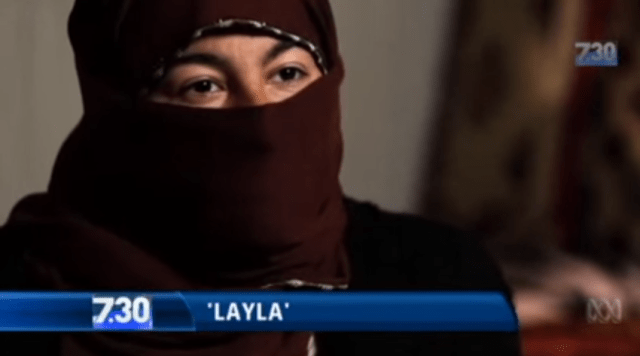
“In Syria, in Raqqa, we were kept in a hall. The Australian then came there and bought us.” ‘Layla’ is a Yazidi woman who, like thousands others, was kidnapped by Da’esh and sold into sexual slavery. She was bought by Khaled Sharrouf, a Lebanese migrant who used to live in Sydney. Having already been convicted and imprisoned for terrorism offences, Sharrouf flew to Syria on his brother’s passport where he began fighting with Da’esh. His Australian wife, now deceased, and children lived there with him. ‘Layla’ says “the children were holding knives and told us that they were going to kill us. They were calling us infidels. “All Yazidis are infidels,” they said. “All the world must convert to Islam.””
‘Layla’
She was one of seven Yazidi women held together in servitude in a house on the outskirts of Raqqa. “We were required to do anything those children asked. We were their servant and slaves. We weren’t allowed to disturb them or rebuke them. That went for the entire family. We had to do anything they wanted.”
Her friend, ‘Nazdar’ says “We couldn’t even cry, they hurt us so much. If we refused anything they demanded of us, they would beat us hard.” A third woman, ‘Ghazala’ said the children had knives and cellphones, “saying that they will take videos while killing us because we follow a different religion. And said that they will make a video while cutting off our heads.”
The sexual violence experienced by Yazidi women is often considered a deeply shameful thing, and many of the survivors have trouble talking about it. But ‘Ghazala’ says “they told two of us to marry him. And he was taking them to a lonely, private room and spending two or three hours with them. Sometimes he was taking one of them late at night and bringing her back in the morning.”
Khaled Sharrouf
Layla hoped that the Australian Government would help her find justice for what Khaled Sharrouf and his Australian comrades have done to her and her friends. She said ”if those terrorists are ever caught, they must make sure that they will never escape. I want them to punish those terrorists…”
When sexual violence is perpetrated as part of an armed conflict, it is a war crime. When that violence is widespread, systemic and directed at the civilian population, it is a crime against humanity. If it used to destroy, in whole or in part, a particular ethnic, racial or religious group, it is genocide. These are crimes under international law; under the Geneva Conventions, the Genocide Convention and the Rome Statute of the International Criminal Court. They are crimes under Australian law, having been ratified through the War Crimes Act, the Geneva Conventions Act and the Rome Statute Act.
Sex trafficking is illegal under Australian law too. The laws have universal jurisdiction, meaning they can be applied even when neither the victim or perpetrator is Australian and the crimes need not have occurred in Australia. Slavery and sexual servitude can also be war crimes and crimes against humanity.
These are heinous crimes, given a special place in the law. They are the reason why the International Criminal Court was established, to end impunity for such violence. Under the principal of complementarity of that court, countries that are willing and able to investigate and prosecute these crimes, are obliged to do so. It is for this reason that the court usually deals with crimes committed in developing countries, places that the justice system and/or political situation do not have the capability to pursue justice.
In Australia, the Australian Federal Police are the responsible investigative authority. Presumably, in cases with such significant overlap of security concerns, investigations would be undertaken with the assistance of other security and intelligence agencies. But last month, rather that issue an arrest warrant for Khaled Sharrouf, the Australian Government simply revoked his citizenship. Now, he is of no greater concern to the government than any of the thousands of other foreign fighters committing war crimes, crimes against humanity and genocide in Syria and Iraq. The prospects of Layla and her friends receiving the justice they seek are now virtually nil.
How then, can this policy of revoking citizenship truly be about justice? Is it just another way for men to decide what women should feel about the ill that has been done to them? For men to decide what security is, what safety is, and what crimes matter the most? How is this fair for those women? How then, is it fair for any women?
If you would like to call on the Australian Government to investigate and prosecute Australians who have perpetrated sexual violence as war crimes, crimes against humanity and genocide in Iraq and Syria, please go to prosecutedontperpetrate.com to find out more and sign the petition now.
The names of the women in this story have been changed for their safety and security. All their quotes were drawn from voiceover translations during a story by Matt Brown on ABC’s 7.30 program. You can watch the whole program below.
Today, the United States has a new President. At the inauguration of President Donald Trump, he gave a speech drawing on the many populist lines he used during the election campaign. There is one common thread between the words spoken by Obama and by Trump. Both men talk about the presidency as the people.
Obama talks about his presidency as by the people, continuing to pay homage to the community organisers who worked to turn the democratic agenda we see in his campaigns, into reality. Key themes of the Obama presidency were change and hope. In his farewell address at Chicago, after reminding people of the key achievements of the administration he said “that’s what you did. You were the change. You answered people’s hopes.” He closed with another call of faith. “I am asking you to believe. Not in my ability to bring about change – but in yours.”
Trump talks about his presidency as for the people. In his inauguration address, Trump said the day marked a “transferring power from Washington, D.C.” to “you, the people.” He said the recent victories of politicians “have not been your victories; their triumphs have not been your triumphs; and while they celebrated in our nation’s Capital, there was little to celebrate for struggling families all across our land.”
But when Obama spoke about “the quiet dignity of working people in the face of struggle and loss” there seems to be an honesty to his words. Despite having graduated from the best schools in America, Obama’s roots in community organising show he has an empathy that seems a stark contrast to Trump. It is his policies that have meant health care costs are rising at the slowest rate in 20 years. It is his policies that bought America back from a great recession. It was under his government that unemployment was cut in half and the American economy saw the strongest two years of job growth since the ’90s.
When Trump said “the wealth of our middle class has been ripped from their homes and then redistributed across the entire world” there is a hollowness to his words. Trump, born a billionaire went on to say that “we will follow two simple rules: buy American and hire American.” However, he could not even manage to have his own campaign made in America. The ubiquitous red ‘Make America Great Again’ caps that dotted the crowd and were a hallmark of his campaign, were made in China, Viet Nam and Bangladesh.
(Chip Somodevilla/Getty Images)
“What truly matters is not which party controls our government, but whether our government is controlled by the people. January 20th 2017, will be remembered as the day the people became the rulers of this nation again. The forgotten men and women of our country will be forgotten no longer. Everyone is listening to you now.” Who does he think he’s listening to? The 20 million Americans who will lose their health insurance when he revokes the Affordable Care Act? The majority of voters who cast their ballot for the policies and personality of Hillary Clinton? No doubt the line is actually an allusion to the so called ‘silent majority’ who surprised the pollsters by voting for Trump.
But when Trump went on to say that “that a nation exists to serve its citizens.” He also said “Americans want great schools for their children, safe neighborhoods for their families, and good jobs for themselves.” Herein lies the ultimate conundrum of Trump’s populism. A nation that exists to serve its citizens is one that welcomes the tired, the poor and the “huddled masses yearning to breathe free.” When the majority runs the country, what happens to the tired, the poor and the oppressed? What happens to the disabled and others with disadvantage?
Let’s face it; 2016 has been a pretty shitty year for women at home and internationally. We have come so close, but are still so far from equality and sometimes, the closer you are, the more painful the absence feels. Then sometimes the gross violence is just sickening.
It started on shaky ground when three of finalists for Australian of the Year were all champions of gender equality: Liz Broderick, Cate McGregor and David Morrison. Then there was bitter disappointments when the Federal Government slashed funding for domestic violence services. Internationally, we have seen ongoing impunity for gross sexual violence in terrorism and armed conflict in the Middle East. The UN Security Council failed to select any one of a fine range of qualified and politically suitable female candidates for Secretary General, and voters in the US elected a misogynist rather than a women for president.
As we know, the Australian of the Year award was given to David Morrison whose primary efforts for gender equality were when he was the senior leader of a large, mixed gender workforce; the Australian Army. While militaries continue to be largely hyper-masculine organisations primarily made up of men (the Australian Defence Force comprises fifteen percent women and the Army twelve percent) he was none the less, employed and appropriately remunerated to lead the Army through the strategic challenges of the day. That leadership should most definitely include an organisational culture that treated women not just as equals worthy of respect, but as valuable contributors to the team.
So Australia’s most public civic recognition was not given to the trans woman who wrote the speech David Morrison is most famous for, nor the woman who developed and implemented the necessary change regime to bring about the required organisational culture for women in defence, but a very privileged, white, middle aged, military man who was already well paid and recognised for his work in the area.
David Morrison is a wonderful individual: a wonderful human being and a wonderful man. I have met him on several occasions and been impressed by his critical insight into gender issues and military culture. However, his recognition came at the cost of recognising a woman who has worked tirelessly on these issues her whole life, bringing about the most comprehensive and effective change regime needed to develop a respectful, just workplace rooted in equality. His recognition came at the expense of a ground-breaking trans woman who has struggled with a wide range of prejudices and spoken with a clear and articulate voice not just on issues of gender equality, but also in her chosen professional field: strategy and defence (and cricket, but that’s a separate issue).
These issues go to the key feminist criticism of the He For She movement. While men’s support for gender equality is vital and appreciated, it cannot come in the form of taking space and recognition from women. Male allies must champion gender equality side by side with women. Often that means they need to cede space to competent, clever and articulate women. They need to use their privilege, their agency, their platform to amplify the voice of those with less privilege.
After a year of Rosie Batty’s indefatigable campaigning on domestic violence, the Federal Government slashed funding to the community legal centres which largely help victims of family violence. These funding cuts came despite a report by the Productivity Commission showing every dollar invested in community legal centres saved the community $18 further down the line. Then, in repeated insults to community sector workers, campaigners and affected women, the government boasted about insufficient piecemeal funding rounds as ‘evidence’ to their support for “ending the scourge of domestic and family violence and sexual assault”.
— WILPF Women, Peace and Security (@Peace_Women) October 17, 2016
In October, the United Nations appointed its ninth Secretary General. Fifty-two nations had joined a campaign to ensure a woman was appointed to the position. Known as the #She4SG campaign, it kicked off in earnest in March 2015. Even the current Secretary General, Ban Ki-Moon, had said it was “high time” a woman was appointed to the role. A total of seven highly competent and qualified women were candidates at various points in a race that was unprecedented in its openness. But none of those women was appointed to the UN’s top job.
The Security Council, who recommends the successful candidate for the General Assembly to approve, said that Antonio Guterres was the candidate who they felt most confident and familiar with. As head of the UN refugee agency, Guterres has often appeared before the Council. But the issues dealt with by other candidates, female candidates, who head different parts of the UN or international organisations, do not come before the Council. Which begs the question, is Guterres’ appointment any more than a very public product of the patriarchal ‘boys club’?
He will likely make an exceptional Secretary General, and has already taken great strides to fill his senior leadership team with strong, capable and diverse women. But we remain sorely overdue for a woman to lead the United Nations.
Last, but not least of course, is the presidential election in the US. Electoral data continues to trickle in, shedding light on who voted for whom. But a vast number of women in the US, and internationally, remain flabbergasted that rather than electing a women president, US voters chose to elect a man with pending fraud and rape charges who had publicly degraded women so often, so grossly and so broadly that it is thought his behaviour has been normalised.
Of course, the election was not run or decided solely on gender grounds. Arguments remain that Americans wanted a candidate who spoke to domestic economic issues. In a system of voluntary voting, people really only turn up to vote when they feel passionately about one candidate or the other. So, had the Democratic National Convention chosen Bernie Sanders as their candidate, the result may have been very different. While many campaigners were excited at the prospects of their first woman president, many of Bernie’s policies and speeches were far more progressive and supportive of women than Hillary’s. But in patriarchal system such as politics, it is because of her sex, that Hillary would have been unable to say many of the pro-women things that Bernie did.
And so, while 2016 was a terrible year for women, we now face 2017 with a US President who sexually objectifies his own daughter, has called for women to be punished for having abortions, shows scant regard for legal or respectful behaviour of men towards women, and has already sought advice on who works on global women’s issues in the State Department.
At home, we see backwards steps in paid parental leave, the key policy that can effectively shape the gender pay gap by encouraging men to take on more care work, and allowing women the flexibility of early child care without having to too much financial burden or to leave the workforce entirely and continue their drop down the career and pay ladder.
Good riddance to 2016, but we have our work cut out for us in the year ahead!
Last month, the United Nations Security Council met for its annual open debate on Women, Peace and Security (WPS). In their statement to the Security Council, the Permanent Representative from Iraq called for assistance strengthening their capacity to address sexual violence perpetrated against women and children by Da’esh.
— NGO Working Group on Women, Peace and Security (@ngowgwps) October 25, 2016
This year marks the sixteenth anniversary of the first WPS resolution, United Nations Security Council Resolution (UNSCR) 1325. UNSCR 1325 emphasised “the responsibility of all States to put an end to impunity and to prosecute those responsible for genocide, crimes against humanity, and war crimes including those relating to sexual and other violence against women and girls”.
There are now a total of eight WPS resolutions, many of which focus on prevention of, protection from and ending impunity for sexual violence in armed conflict. The most recent, UNSCR 2242 reiterated the need for the “implementation of relevant obligations under international humanitarian law and international human rights law.” It also affirmed “the primary role of Member States to implement fully the relevant provisions of Security Council resolutions on women, peace and security”.
International campaigns such as Stop Rape Now have sought to bring attention to sexual violence in armed conflict. But these gendered crimes are often being perpetrated outside the jurisdiction of institutions willing and able to bring the perpetrators to justice. In 2014, Angelina Jolie and William Hague launched the Preventing Sexual Violence Initiative with projects to aid in the documentation and investigation of sexual violence in conflict. Despite advances at the International Criminal Court, these crimes are often still overlooked.
If countries prosecuted their own nationals for these crimes we would finally go some way to achieving justice for the victims, ending impunity for sexual violence in conflict, and implementing the WPS agenda. In countries such as France, Germany, and the United Kingdom, war crimes, genocide and crimes against humanity are outlawed in domestic legislation. Finland and Sweden have already bought cases against their nationals.
Sexual violence can be prosecuted as a violation of the laws or customs of war, Common Article 3 to the Geneva Conventions, the Fourth Geneva Convention, or both Additional Protocols I and II to the Geneva Conventions. In Australia, war crimes and violations of the laws and customs of war are criminalised in the Geneva Conventions Act 1957 (last updated in 2009) and the War Crimes Act 1945 (last updated in 2010). These two acts have been incorporated in Division 268 of the Criminal Code Act 1995.
The Rome Statute of the International Criminal Court recognises rape, sexual slavery, forced prostitution, forced pregnancy, forced sterilisation and other forms of sexual violence as crimes against humanity if the action is part of a widespread or systemic practice.
Da’esh has indeed developed a widespread and systemic practice of sexual slavery and rape. There is dedicated infrastructure for the enslavement, trafficking and rape of women and girls. Investigations have uncovered a network of warehouses where the victims are held, viewing rooms where they are inspected and marketed, and a dedicated fleet of buses used to transport them. Da’esh has developed a detailed bureaucracy of sex slavery, including sales contracts notarized by their own court system. They have published an entire doctrine codifying their practices. In order to comply with this doctrine, women are forced to take oral contraceptives to ensure they are not pregnant while being raped.
For sexual violence to be considered “a constitutive act with respect to genocide,” it needs to have been committed with the intent to destroy, in whole or in part a national, ethnical, racial or religious group. The United Nations Human Rights Council has published a damning report, outlining Da’esh’s ongoing genocide of the Yazidis. Genocide has been a crime under Australian domestic law since 2002, when the federal government finally passed the Genocide Convention Act 1949.
Friday 25 November marks the beginning of the annual 16 Days of Activism Against Gender Violence campaign. It will be marked by the launch of the ‘prosecute; don’t perpetrate‘ campaign, calling on the Australian government to investigate and prosecute Australians who have perpetrated these crimes. It is high time we used our own laws, to investigate and prosecute our own citizens for sexual violence perpetrated by Da’esh in Iraq and Syria. Today is the most pertinent day to turn our minds to ending impunity for sexual violence in armed conflict. These laws exist; we know the crimes have been perpetrated. Now we need to develop the political will to allocate the resources, investigate individual cases and prosecute them.
When I was 11, I told my father I wanted to be president of the United States. He told me, without hesitation, that I could be whatever I wanted to be if I worked hard. I never doubted that. Yet, life soon showed me just how hard women often have to fight to simply be whatever they want or feel led to be.
While we’ve certainly made strides, society still compels women to somehow justify our choices or actions in a way that men don’t have to. You’ve broken a lot of ceilings throughout your career, and I don’t need to tell you how intense, dirty, and thankless the world of politics can be; how washing your hands of the whole thing and hiding in a cave somewhere would be an easy and welcome respite.
But you didn’t hide. You never shied away from adversity. You’re not perfect, but no one is. You were brave enough to keep going, keep fighting, and keep putting yourself out there, because you believed in something bigger and better. And even though it means a lot to us women, you didn’t just do it for us: you did it for everyone.
So, thank you. Thank you for your stamina and grace. Thank you for giving our generation and all future generations an example of what is important and great in this already-great country. And thank you from an 11 year old girl, who 22 years later remains committed to the causes of justice and equality and will continue down this path you and others before you have lit for us.
We are indeed stronger together.
Onward,
Brittany Persinger
Brittany is an international security professional who lives in Arlington, VA. Follow her on Twitter at @BrittForPeace.
As the battle for Mosul rages, we need to remember that war crimes have driven this conflict. Gendered war crimes have been the hallmark of Da’esh who have kidnapped women, published entire doctrines on the use of sex slaves, and thrown LGBTQI people off rooftops for their sexuality. There needs to be justice for those crimes. Their evidence needs to not be destroyed by the current offensive.
Rape has been used as a weapon of war; a war crime. It has been so widespread that it constitutes a crime against humanity. Furthermore, sexual violence has been used as constituent of genocide against the Yazidis. These crimes have been reported by the United Nations and many local and international activists.
The international nature of this conflict means there is the greatest scope for international justice for victims of these crimes. It has been reported that France is going to take Russia to the International Court of Justice for war crimes in the siege of Aleppo and the French prosecutor has been investigating Assad for war crimes since last September.
Foreign Fighters in Iraq and Syria (Credit: Radio Free Europe)
At the peak of Da’esh’s power some 30 000 foreign fighters filled their ranks. Many of these fighters came from places where war crimes, crimes against humanity and genocide are outlawed in domestic legislation. The principle of complementarity of the International Criminal Court means that countries who have signed the Rome Statue and have the willingness and ability, must investigate and prosecute these crimes. Finland and Sweden have already bought cases against their nationals. It is time countries like Australia, the United Kingdom and Belgium do so too.
However, investigation and prosecution of international crimes is incredibly difficult. Even when a competent authority has jurisdiction, gathering of evidence is problematic in a war zone, thousands of miles from home.
Yazidi activist, Ameena Saeed Hasan has called on planners of the Mosul offensive to consider Da’esh’s 1400 captives in their operational planning. US Ambassador to the United Nations, Sarah Mendelson has said the announcement of the Mosul offensive ahead of time allowed Da’esh to hide its captives. As such, it is all the more important to ensure considerations of investigation and evidence are integrated into the planning and conduct of military operations currently underway in Iraq.
— WILPF Women, Peace and Security (@Peace_Women) October 17, 2016
Australia, the US and other nations supporting the Iraqi military have national action plans on women, peace and security. These action plans are based on the suite of UN Security Council resolutions that oblige member states to protect women from the effects of armed conflict (particularly sexual violence) and ensure their participation in conflict prevention, mitigation and recovery.
These resolutions identify sexual violence not only as a crime against humanity or constituent of genocide, but also a threat to international peace and security. Security Council Resolution 2106
affirms that sexual violence, when used or commissioned as a method or tactic of war or as part of a widespread or systemic attack against civilian populations, can significantly exacerbate and prolong situations of armed conflict and may impede the restoration of international peace and security
This time last year, the Security Council passed resolution 2242, reiterating the need for “implementation of relevant obligations under international humanitarian law and international human rights law”. That resolution also
called for the greater integration by member states and the United Nations of their agendas on women, peace and security, counter-terrorism and countering violent extremism
As such, it is absolutely imperative that the documentation and investigation of international crimes be fully considered in the planning, conduct and transition activities undertaken by security forces in Mosul. It is necessary for us to meet our obligations under international law, within the Security Council resolutions and within our own policy documents.
I don’t much go into New Year’s resolutions, but this time last year a friend of mine suggested I resolve to not spend a single dollar at Coles or Woolworths for the entire year. Given my view of these two monolithic stores, and my food ethics, it was a challenge I wanted to accept. The year is almost done and I’m now taking the time to reflect on how I achieved the challenge.
The greenhouse emissions of the transport system that takes fresh food and other grocery items from their country or place of origin, to a wholesale market, to a warehouse, trucked to a grocery store, and sometimes onto a second or third store are huge. Products criss-cross the country, and sometimes the world. If you try buying a locally grown mango in Darwin, and it will have been shipped to the wholesale market in Brisbane, before being trucked all the way back to Darwin for retail sale. Then there’s the food miles of importing foods like garlic (commonly imported from China), lemons (often from the USA) or asparagus (from Peru) into that system for them to be bought to you in the off season. On top of that, there’s the hydroflurocarbons (HFCs) and hydrochloroflurocarbons (HCFCs) used in the refrigeration of all that food throughout its journey. Many of these chemicals are potent greenhouse gases. HCFCs also deplete the ozone layer. HCFC-22 is the most common refrigerant in Australia.
Leslie, from Small Cow Farm, with my favourite blue cheese
Fresh produce
Beautiful, plump figs
Locally grown avocados
I recognise how lucky I am to have such a good quality farmers market so close, on such a regular basis. I firmly believe that weekly farmers markets are the way to change people’s shopping behaviour, with this regularity there is a viable shopping alternative that can be relatively easily incorporated into a routine. A fortnightly market may be OK, but a monthly market will only lead to specialty and luxury items that people might buy for a treat. A monthly market does not provide a serious alternative for daily food items. I urge market organisers, and communities considering the beginning of a farmers market to plan for a weekly market, containing as much locally produced food as shoppers would reasonably consume within the seasons.
I would highly recommend upcoming markets look for inspiration from the Capital Region Farmers Market. They take great effort to get good variety of produce so that it is possible for shoppers to buy all their food there each week. This does not mean that everything on offer at the supermarket is available at the farmers market, but with due consideration of seasonality and what actually grows in the region, you can easily buy food for a balanced, healthy diet.
In spring and summer I also do a lot of foraging for wild greens, edible weeds and a variety of fruits that I eat fresh and preserve. There’s not much better than walking downstairs to the nature strip to pick some purslane, wild brassica or sheep sorrel to go in your salad. It’s far tastier than shop bought greens, packed with nutrition, and doesn’t cost a cent. It’s also a wonderful excuse to get into nature and relax outside. It’s certainly a superior experience than a peak hour visit to the supermarket.
Purslane growing in the nature strip
Sheep sorrel
Dry goods
I buy my flour, nuts and dried beans from my local food co-op. The prices are very reasonable, the range is quite extensive and there are a lot of organic options. The co-op is on my bike ride from home to my office. I take my clear cubes and reusable tins into the store and weigh the containers before filling them up. If you volunteer your time once a month, you get a reasonable discount on your shopping items. They have a good supply of other local fresh produce including fruit and veg, vegan cheeses, tofu and fermented foods. They also have bulk liquids like honey, vinegars, and molasses that you can pour into your own reusable jars and bottles.
I buy most of my cleaning products, soaps, shampoo, toothpaste and such from my local IGA. I am happy to buy items from them because the store is walking distance from my apartment, the service is friendly and personal, and I prefer to support independent and family owned/operated business. IGA stores are always stocked with items that are reflective of the locals and the owners, providing a community feel that I prefer to the nationwide grocery chains. While IGA still has some power of collective purchasing, stores have more flexibility to buy from local suppliers and don’t have the same power to force unreasonable expectations on suppliers.
I buy my household cleaning products, including soap powder, dish detergent and shower cleaner from IGA. Although, I have just started replacing my shower cleaner with a natural vinegar solution. I often use bi-carbonate of soda for cleaning items such as the stove top, but I buy that from IGA too.
I buy all my laundry products from IGA. I use Aware soap powder to wash my clothes, it comes in a recycled cardboard box, is good to use in a front loader, and is free of the optical brighteners that fade coloured fabrics over time. I have however, discovered that my local food co-op sells bulk laundry detergent, which I may start to use instead of the boxes I buy at IGA. I buy a eucalyptus based wool wash by Earth Choice and the very occasional block of Sard soap for hand washing stubborn stains and grime out of whites.
Shampoo and conditioner were the hardest items for me. I like to buy in large containers, to minimise the packaging I’m responsible for. I like to use a silicon and paraben free shampoo. My IGA doesn’t stock the ‘natural’ version of the brand I like to use. In Canberra, we are lucky have a third supermarket chain, Supabarn. Supabarn does stock my Tresemme shampoo, but the stores are entirely out of my way. This has led me to consider changing brands, to a more ‘natural’ gentler shampoo that is available at my local chemist. The bottles are not available in as large a size as my Tresemme products, but they are organic, made in Australia and smell great.
I buy my shower soap from the farmers market. I love that the market rules only allow food and fresh produce stalls, but several of the olive producers have been allowed to sell olive oil soap alongside their other products. I buy a bar of olive oil soap produced by Homeleigh Grove just on the outskirts of Canberra. It has minimal packaging, is lovely and gently on the skin, and I personally like the people who produce it. I also buy the mini soap bars to put on the towel of my AirBnB guests, as a personal little, local touch.
I recently watched a great little video about how much change you can bring to the world by changing your own behaviour. It makes such a difference. Not only are you reducing your negative impact on the world, by choosing a better way, buying into better, more ethical and sustainable systems, you are making a constructive difference. You are modelling that positive behaviour to your friends and community, and supporting others who are working and living in similarly positive systems.
Will you give it a go this coming new year? Can you do a year without Coles and Woolworths? I would not be surprised if you find it as enjoyable as I did.
If you’d like to read more about the food portion of this shopping challenge, you can head over to my food blog: Susan’s Sumptuous Suppers.



 ISHO (ĭsh'ōō)